Lisa A. Pierson, DVM
Think about the last time you swallowed a pill or a capsule. You most likely took it with several swallows of something liquid to help move the pill along its journey through the esophagus and into the stomach. Most people would never dream of ‘dry swallowing’ pills, having felt that awful sensation of a pill not ‘going down’ very smoothly so why are we subjecting our animals to this illogical procedure? When humans feel that a pill is stuck, we usually react by drinking more water. It would be nice if cats and dogs reacted this way, but they don’t.
Note: When I use the word “pill,” I am also referring to capsules which can cause even more problems than pills, as shown in the study below.
Here is a quote from a colleague of mine:
Last year, I was prescribed clindamycin (Antirobe) for a dental infection and was instructed to take each capsule with a full glass of water. One night, being lazy, I took the capsule with just a gulp of water. What ensued was the worst case of heartburn/esophagitis I have ever had. At first, the pain was so intense I thought I was having a heart attack. This cured me of ever pilling a cat without a water or food chaser.“
Given how humans take their medications and vitamins (with a liquid in some form), we need to stop asking our cats and dogs to do something we would never do.
The lining of the esophagus is very delicate and it is not designed to have irritating medications in contact with it for more than the short amount of time it should take for the pill to pass from the mouth to the stomach when swallowed with an adequate amount of liquid or food.
When a pill is in contact with this tissue for a prolonged period of time, a painful irritation or ulcer has the potential to develop. Some medications are worse than others. For instance, doxycycline is a well-known antibiotic that is extremely irritating. (More on that below from a human who experienced very painful erosive esophagitis from taking this medication without enough water.)
For this article, a “dry swallow” refers to the administration of a pill or capsule to a cat or dog without the patient immediately (within 1-2 minutes):
1) consuming some food or liquid (milk, tuna water, meat broth, etc.) voluntarily – or
2) having 4-5 milliliters (cc) of water, milk, tuna water, or meat broth given orally via a syringe.
Offering food, tuna juice, milk, meat baby food, or a meat broth for them to lap up on their own results in less stress for the patient but many animals are not keen on eating or drinking right after a human as ‘pilled’ them.
As noted on my Feeding Your Cat: Know the Basics of Feline Nutrition article, as well as in many other articles on this website, I am strongly opposed to the feeding of dry food to cats. That said, if you are dealing with a dry food-addicted cat, feeding a bit of dry food or treats (such as Temptations treats) after administering the pill will also help ‘chase’ it into the stomach, but canned food – with its much higher water content – is a healthier choice.
Hopefully, after looking through my website, you will be convinced to get your cat on a better diet than dry food. See my Tips for Transitioning Dry Food Addicts to Canned Food.
Tip: You can make your own tuna water by mixing a can of tuna with ~3 cups of water. Mash it up and let it sit for ~10-15 minutes. Then pour the water off into ice cube trays to prolong the freshness then store the cubes in a ziplock bag. It is fine if some tuna meat is included into the ice cube unless you will be syringing this flavored water. If you are using a syringe to administer the water – versus letting them lap it up – then I would strain the water to remove any chunks of tuna that would clog the syringe.
Rather than ‘pilling’ a cat or dog, by far, my absolute favorite way to administer pills or capsules is with the use of Pill Pockets.
If the cat refuses to eat Pill Pockets, even when rolled in FortiFlora, paremsan cheese, or crushed Temptations treats, an alternative to pilling is to have the medication made up into a flavored liquid compound for ease of administration. That said, some people state that their cat is not good about swallowing liquids and these people prefer to use pills.
Back to Pill Pockets….
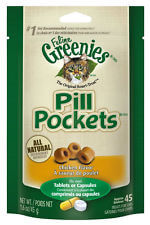
Do not use a whole Pill Pocket at a time. They are too big and most cats will bite down on them. Instead, use just enough of the ‘dough’ to wrap around the pill – being careful not to get any of the pill powder on the outside of the Pill Pocket if you have broken up the pill into pieces.
A cat is going to be much less apt to bite down on ~1/4 of a Pill Pocket than he will be if offered a whole Pill Pocket. I break the Pill Pocket into 4 – 5 pieces.
See this video showing how I broke a Pill Pocket into 5 pieces and then rolled them into little balls. The first two pieces have 1/2 of Andy’s pill in each of them. The other 3 pieces are also fed as a treat and also to help push the pill down into the stomach.
Note how I quickly throw down each piece. This is to get Andy to swallow the one that is in his mouth which he does because he is anxious to gobble up the next piece.
Again, if your cat will not eat Pill Pockets, try rolling them in crushed up treats such as Temptations treats or FortiFlora. FortiFlora is a probiotic (beneficial bacteria) that comes in a box with 30 small packets but I am not suggesting it for its probiotic purpose. The reason why I love this product is because the probiotics are contained in a very enticing animal digest powder. This is what is sprayed on dry kibble to make it so palatable.
I think that my cats would eat cardboard if I sprinkled FortiFlora on it! I always keep this product in my home as a flavor enhancer to be used if my cats don’t want to eat for any reason or if I am trying to get them to eat a new food. Think of it like salt and pepper for your own food. You can use as little as 1/10 of a package or even less. Also, don’t worry if the product is outdated because we don’t care if the probiotic bacteria have died since we are only using it for a flavor enhancer.
FortiFlora is my favorite trick listed on my Tips for Transitioning Dry Food Addicts to Canned Food paper but Temptations treats may work just as well and will be easier to find at your local pet store.
Some cats also love parmesan cheese so you can also try rolling the Pill Pocket in parmesan cheese.
When administering pills or capsules, some people use butter or oil to coat the pill/capsule. This may make swallowing the pill easier but it is not going to ensure rapid passage into the stomach. Therefore, it is still very important to follow a butter-coated pill with a liquid or food chaser to ensure that the pills or capsules move immediately into the stomach.
If a cat absolutely will not allow water to be syringed after pilling, or he will not eat or drink afterward, then you can put some butter or a product like Nutrical on his paw. The licking of the butter/Nutrical from the paw (or even the nose) has been shown to hasten the travel of the pill into the stomach but it is not as effective as having the cat eat after pilling or ‘chasing’ the pill with 4-5 cc of water or a flavored liquid.
The best size of syringe to use for a cat – whether you are syringing the medicine or a water chaser – is a 1 ml (cc) syringe. The larger syringes do not fit comfortably inside of a cat’s mouth. Also, you do not want to administer any more than 3/4 – 1 cc at a time. If liquid medications, such as some of the commonly used antibiotics, are dispensed with an eyedropper, ask your veterinarian for a 1 ml syringe. Not only is this a more accurate way to measure the dose, but your cat will be more agreeable to this small syringe entering the side of his mouth rather than the larger eyedropper that you have to squeeze a couple of times to eject the medication.
If you have chosen the option to pill your cat, I would suggest that before you get ready to administer the pill, have a bowl of water (or tuna juice or broth or milk) readily available. See if your cat is interested in drinking it. If not, you will then have to use your syringe. To administer a liquid using a syringe, it is best to approach the cat from the side, not from the front. Cats tend to get worried when approached head on. Slip the syringe into the side of the mouth at about a 45-degree angle being careful not to insert the syringe too far down the back of the throat. You don’t want the cat to panic, nor have him aspirate the liquid.
Do not hold your pet’s head up!
This is something that I commonly see people do. Try it yourself. Lift your chin up and note that it is impossible to swallow. You can hold his head level or his mouth slightly down, but never raise his head upward.

I fully understand that some of the readers will be saying “oh sure…I can barely get the pill down my cat and now I am supposed to follow up with the syringing of some liquid?!!?”
I realize that none of this will be easy with some cats, but my goal is to get people to start thinking about this issue and not take the dry pilling of an animal lightly. For those hard-to-pill cats, please see below for other alternatives such as compounded, flavored liquid medications and transdermal preparations.
Another option is to see if the cat or dog will consume the pill if it is hidden in canned food. This is obviously the least stressful for all concerned and it works much better with dogs when compare to cats. Cats are notoriously picky eaters and are suspicious of anything out of the ordinary in their food and it would be very rare to have a cat eat a whole pill when mixed into cat food.
Some drugs such as Clavamox tablets and Baytril TasteTabs are formulated to be fairly palatable and can be crushed and put in canned food and this is a great way to go….if the cat will eat it.
I have had better luck with cats eating crushed Clavamox tablets (tasteless) in food than I have with the Baytril TasteTabs. I have treated many feral (wild) cats with clavamox tablets crushed and mixed into food.
Please note the following case study where another antibiotic, clindamycin (Antirobe), resulted in severe injury – and some deaths – to the patients when they were dry pilled.
~~~~~~~~~~~~~~~~~~~~~~~~~~~~~~~~~~~~~~~~~~~~~~
Suspected clindamycin-associated oesophageal injury in cats: five cases
Journal of Feline Medicine & Surgery, Volume 8, Issue 6, December 2006, Pages 412-419
Julia A. Beatty BSc(hons), BVetMed, PhD, FACVSc (Feline Medicine), MRCVS, Nigel Swift BVetMed, Dip ACVIM (Small Animal Internal Medicine), MRCVS, Darren J. Foster BSc, BVMS, PhD, FACVSc (Feline Medicine) and Vanessa R.D. Barrs BVSc(hons), MVetClinStud, FACVSc (Feline Medicine)
Accepted 24 April 2006. Available online 18 July 2006.
Summary:
The clinical findings, treatment and outcome of suspected clindamycin-associated oesophageal injury in five cats are reported. All cats were treated with one 75 mg clindamycin capsule twice daily (dose range 12–19 mg/kg). Capsules were administered without food or a water bolus. Dysphagia, regurgitation, choking or gagging were seen 3–9 days after starting clindamycin. On oesophagoscopy, three cats had oesophagitis, one of which progressed to stricture formation. Two cats had an oesophageal stricture at first presentation. This is the first report of suspected clindamycin-associated oesophageal injury in cats. It serves to further alert practitioners to the potential for drug-induced oesophageal disorders (DIOD) in cats treated with oral medications and to urge prevention by promoting a change in dosing practices.”
End abstract.
Personally, I have dealt with 3 cats that have died post-pilling with clindamycin (Antirobe) tablets.
~~~~~~~~~~~~~~~~~~~~~~~~~~~~~~~~~~~~~~~~~~~~~~~~~~~~~~~
Please note this excerpt from the study quoted below:
After 5 minutes 84% of capsules and 64% of tablets are still sitting in the esophagus.”
This is referring to pills and capsules that were dry swallowed.
It really is amazing that cats and dogs are as good as they are about pilling but one has to wonder about the pets that panic and/or gag when their owners try to pill them. I know that I would not be very happy about being asked to dry swallow a pill.
A Very Interesting Study
The following is a summary of a very interesting article that appeared in a veterinary journal entitled Evaluation of the Passage of Tablets and Capsules Through the Esophagus of the Cat. It is from a paper presented at the 2001 American College of Veterinary Internal Medicine Forum. (They do note at the end of the paper that the principles outlined also make good sense for dogs.) This paper was submitted to one of the lesser-read journals so a lot of veterinarians may not have seen it. This is extremely unfortunate for all cats and dogs.
Purpose of the study:
The goal of the study was to determine the length of time that it took for pills or capsules to enter the stomach after 1) dry pilling and 2) pilling and then giving a 6 cc water chaser immediately following the administration of the pill or capsule – referred to as a “wet swallow.”
Study design:
30 cats were used. Fluoroscopy was used to evaluate the pill/capsule passage at 30, 60, 90, 120, 180, 300 seconds.
Study results:
For the dry swallows:
No pills were in the stomach at 30 and 60 seconds. Only 6% of the pills were in the stomach at 90 seconds. Only 13% of the pills were in the stomach at 120 seconds. And at 5 minutes only 36% of the pills were in the stomach.
For the wet swallows: (i.e., the pill was followed by 6 cc of water)
At 30 seconds, 90% of the pills were in the stomach. All pills were in the stomach by 120 seconds.
The statistics were even worse for capsules when dry swallowed. By 5 minutes, only 16% of the capsules had made it to the stomach. 100% of capsules followed by water chasers, were in the stomach by 60 seconds – faster than for pills probably due to the smoother surface of a capsule versus a pill.
Commentary:
This is an interesting study that has considerable practical impact. Although veterinarians have a huge arsenal of mediations and treatments available to us, we still have a very poor understanding of some of the most basic aspects of everyday practice. We routinely prescribe oral medications in the form of tablets or capsules to cats.
It has been our assumption that when it was possible for the owner to actually give the pills or capsule to the cat, it would make it into the stomach reasonably rapidly. It turns out that this is inaccurate. After 5 minutes 84% of capsules and 64% of tablets are still sitting in the esophagus. Similar results were published in another study by JP Graham (American Journal of Veterinary Research 2000).”
Practical outcome:
The main concern with this information is that if tablets and capsules sit in the esophagus for a prolonged period of time, this can cause damage to the tissues in this area. This damage can lead to esophagitis, which can lead to nausea, vomiting and megaesophagus. At times, the esophagus can also respond by developing an ulcer or stricture. The latter is a very serious complication requiring aggressive therapy, preferably with balloon dilatation.
In addition, we probably have all had that uncomfortable feeling when a tablet we have taken has gotten stuck on the way down. This could be the cause of vomiting in some cats that are medicated. It is quite frustrating to win the battle to get the pill or capsule down a cat and then have it vomited up several minutes later.
Both this abstract as well as the study published by Graham et al., clearly point to the need to administer either water or food after a cat has been pilled with a tablet or a capsule. This will hasten the movement into the stomach and cut down on the chances of the tablet or capsule remaining in the esophagus for a prolonged period of time. Although comparable studies have not been done in dogs, this advice is sound in dogs, as well.
The following is an anecdotal report from a person who ended up with a very painful case of an ulcerated esophagus after a capsule became lodged in her esophagus:
I know the pain of an ulcerated esophagus personally and it is a living hell. I was on doxycycline capsules (due to a cat bite) last year and one got stuck in my esophagus. I did not think it was a big deal and went to bed figuring it would eventually work it’s way down. Several days later I had suffered so much that I took myself to the ER. I had to drink this horrible tasting cocktail with liquid lidocaine to get relief. It worked, temporarily, but I had to drink a tsp of the lidocaine 3x a day just to be able to swallow for about 30 minutes each time. Forget eating. I lost 10+ lbs in less than 2 weeks. I couldn’t eat at all and could not swallow without the lidocaine. I laid in the bed with a cup to spit in because it was too painful to swallow. It was a great diet, but not one I’d recommend. Please take every precaution you can to make sure this does not happen to your pet.”

Compounded Flavored Liquid Medications
As an alternative to using pills and capsules to administer medications, certain pharmacies can compound the medications into flavored liquids. Please be aware that compounded medications may be more expensive than medications dispensed by your veterinarian, but the use of these liquid medications can alleviate a great deal of stress for both the pet and the human.
I am very involved in rescue work and often deal with extremely frightened and painful animals whose trust I am trying to gain. Pilling a sick cat/kitten who is feral or traumatized/frightened/painful, or has severe upper respiratory disease and can hardly breathe as it is, does not exactly make for a fast friendship and development of trust.
When an animal is ill or injured, the last thing we want to do is add more stress to the situation. I adopted a 9 year old cat out to a really nice woman many years ago. Toward the end of Caliban’s life, the lady called me in tears because Caliban was now in congestive heart failure and she was having a hard time pilling him and was going to put him to sleep since he could no longer receive his necessary medications. She felt so guilty for failing Caliban by not giving him the medications that he desperately needed but was also feeling guilty for stressing the heck out of him in his final days with the pilling. This stress was alleviated by using compounded, flavored liquid medications.
The most common flavor used for cats is ‘triple fish’ and if dealing with a very bitter medication, this flavor is the best one to use. Another flavor that is used is chicken and some cats do better with this milder flavor than the very strong triple fish.
Please note that some drugs are so bitter that even compounding will not hide the awful taste. An example of this type of drug is amitriptyline which is often used for anxiety and inappropriate elimination (not using a litter box) problems. Fortunately, this medication is formulated into a small, coated pill but a food or liquid chaser still needs to be administered if the cat is pilled.
Or, much better would be to use Pill Pockets.
4/26/10 update: In cases where I have deemed medications necessary, I have had good luck with Prozac for inappropriate elimination problems and it is easier to give than amitriptyline. I have one patient that was scheduled for euthanasia for constantly urinating on the owner’s bed. I put the patient on a small dose of Prozac that is fed to her every night in a Pill Pocket. The owner splits the Pill Pocket into three pieces and only one piece has the tiny pill piece in it but the cat gets all three treats each night. No stress to either the owner of the patient….and the cat has not (knock on wood….) urinated on the bed for the past 8 months.
2/24/11 update: The patient discussed above decided that she did not want to eat Pill Pockets anymore but she is now readily eating them if they are rolled in FortiFlora first.
Since we all know that every cat is different, I will mention again that some people state that they have much better luck pilling their cats than trying to get liquids into them. Some cats throw a fit if given liquid medications. The problem with these cats, however, is that if you do pill them successfully, they are not apt to take the water chaser very well. This presents a bit of a problem and the hope is that they will eat some canned food or drink some tuna juice or meat broth after being pilled.
Another favorable aspect of using a compounding pharmacy is that you can pick the drug concentration so that the necessary dosage volume is not over 1cc. I try to have the medication mixed in a concentration that enables me to give 3/4 of a cc or less. This is an easy volume to administer to a cat.
Occasionally you may run across a drug that can’t be compounded but I have yet to run into this situation.
Transdermal Medications
Transdermal preparations are medications that are formulated into a gel or ointment that can be applied to the inner ear of the cat. That said, the only frequently used medication that has shown to be adequately absorbed by this route is methimazole (Tapazole) for hyperthyroidism.
Studies here and here have shown that the use of transdermal methimazole is an effective way to administer this drug and results in fewer gastrointestinal upsets.
Unfortunately, many veterinarians are under the mistaken impression that other medications like steroids, antibiotics, and behavior-altering drugs are adequately absorbed through the skin when they are not.
Conclusion
The goal of this article is to prevent the silent suffering that our pets often go through when medications are administered without appropriate precautions. I have outlined several options above:
1) FIRST CHOICE: Try Pill Pockets. If the patient will not eat Pill Pockets, try rolling them in parmesan cheese, FortiFlora, or crushed Temptations or Pounce Treats.
2) Use compounded, flavored liquid medications.
3) Administer the pill or capsule and follow up with the feeding of their regular food, baby food, tuna juice, a meat broth, or milk. Dry food or dry treats can also be used but a higher moisture ‘chaser’ is preferred.
4) Administer the pill or capsule and follow up immediately with a chaser of a 4-5 cc of a liquid using a syringe.
5) Use transdermal preparations. (Tapazol only)
6) Or…be lucky enough to have your cat eat the medication in canned food.
Please pass this information on to anyone whose pets may benefit from the information. It is my hope that the information will help to save some of our non-speaking friends from a painful esophagitis and their caretakers from the stress of pilling some hard-to-pill cats.
Updated November, 2016
Lisa A. Pierson, DVM