Lisa A. Pierson, DVM
 French translation Spanish translation
Important points:
- Any cat that is having trouble urinating may have an obstructed urethra which is a medical emergency.
- “Water” is the most important word when considering urinary tract health.
- Feeding a water-rich, low mineral, diet of canned or homemade food is critical for urinary tract health.
- Feeding dry (water-depleted) food contributes significantly to urinary tract dieases.
- Cats consume double the amount of water when fed a water-rich diet versus dry food. This fact considers both sources of water: food and water bowl.
- Urinary tract infections are significantly over-diagnosed leading to antibiotic abuse.
- Blood in the urine is not necessarily indicative of an infection.
- Cases of sterile (non-infectious) cystitis (inflammed bladder wall) are far more common than infections.
- It is important to define the “I” in “UTI.” Infection? Inflammation?
- Crystals are very commonly erroneously diagnosed and over-treated with so-called “prescription” diets.
- I do not use any prescription diets other than the occasional use of canned s/d, temporarily.
Many cats suffer each day because of the water-depleted diets (read: any dry kibble) that humans insist on feeding to them. Out of all of the subjects discussed on my website, urinary tract health – especially urethral obstructions – is the subject that I am most passionate about.
If the reader had to witness the tremendous suffering that a cat must endure when his (or, rarely, her) urethra becomes obstructed they would understand why this subject is so important.
See Opie’s pictures below.
To be quite frank, if humans – including many of my veterinary colleagues – had a cork inserted into their urethra until they experienced the excruciating pain secondary to bladder distension and rupture, I have no doubt that they would start to take this issue much more seriously and STOP condoning the feeding of dry food to cats.
And while urethral obstructions cause tremendous pain and suffering and can result in death if the bladder ruptures, cystitis (bladder inflammation) is also extremely painful. Many of these cats, understandably, develop litter box aversions secondary to associating the litter box with their pain. This results in house soiling and cases of abuse when the poor cat is punished.
If I could have the reader of my website leave with one word firmly imprinted in their mind it would be “water.” If your cat is on a properly hydrated diet of 100% canned food – and no dry food – you stand a very good chance of never needing to read this webpage.
Note that I said “water” – not “crystals” or “urine pH” – or any of the expensive, low-quality, “prescription diets” often recommended by veterinarians.
Always keep in mind that water flowing through the urinary tract system is the most important factor in keeping it healthy. That said, please do not make the mistake that so many people make when they state “but my cat drinks plenty of water!”
A cat’s normal prey is ~70% water. Canned food is ~78% water. Dry food is ~5-10% water. Cats have a low thirst drive and they do not make up the deficit at the water bowl. They are designed to get water with their food.
Total water intake – dry vs canned
Cats on canned food have been shown to consume at least double the amount of total water when compared to dry food-fed cats when all sources of water (food and water bowl) are considered.
This results in approximately double the amount of urine flowing through the bladder.
Think of canned food as not only a proper diet for an obligate carnivore, in general (see Feeding Your Cat: Know the Basics of Feline Nutrition), but also understand that it is the healthiest way to keep your cat’s bladder flushed out and ‘happy.’
When choosing a diet for their cat, I find that many people are fixated only on carbohydrates and fail to miss the very critical point that all dry foods – including the low carbohydrate options – are water-depleted.
~~~~~~~~~~~~~~~~~~~~~~~~~~~~~~~~~~~~~~~~~~~~~~~~~~~~~~
I receive hundreds of emails every year from people asking me what diet to feed their cat after urinary tract problems have been noted.
Unfortunately, many of these people and their veterinarians have missed the point of water…water…water and have continued to put the cat in danger by feeding/prescribing a dry food diet – including any and all of the prescription dry diets.
It is highly counter-intuitive to label any water-depleted (read: DRY) food as a “urinary tract diet.”
Generally speaking, the basic diet recommendation for the average cat with urinary tract issues is a high protein/low carbohydrate canned food with added water.
Taking it one step further, if the patient has a properly documented problem with bladder stones or a large amount of crystals, look for one that is low in phosphorus – either below ~1.0-1.2% dry matter (not ‘as fed’), or below ~300 mg/100 kcal.
(In the “properly documented” Crystals section linked above, pay close attention to the 5th bullet point.)
Protein, carbohydrate, and phosphorus content (mg/100 kcal) are listed for many canned foods on this chart.
Unfortunately, it would take me far too long to keep up with the new products on the market so if you want to know the specifications of the food you are feeding, please see the Contacting Pet Food Companies section on my Commercial Canned Food page for dialog that you can use when calling them.
When considering water versus phosphorus content, as noted above, the water issue is the most important but if you are really worried about crystals (even though they are not an abnormal finding in cat urine as discussed below), pick a diet that is low in phosphorous.
Phosphorus is a general indicator of the calcium and magnesium load of the diet. If a diet is low in phosphorus, chances are it is also fairly low in calcium and magnesium since all of those minerals are high in bone material and if a diet is low in phosphorus, it is probably low in bone matter.
Note that fish tends to be high in phosphorus because fish comes with its own bones so stay away from fish.
Also see prescription diets below.
If you are tempted to write to me to ask which diet to feed to your cat, please understand that no advice will be offered via email. If you wish to discuss your cat’s individual case, an appointment for a phone consultation can be set up but only after providing your cat’s medical records for my review.
~~~~~~~~~~~~~~~~~~~~~~~~~~~~~~~~~~~~~~~~~~~~~~~~~~~~~~~
If you do not want to read this entire webpage, please at least scroll down to see Opie’s pictures. Opie is a very sweet, (previously dry food-fed) cat that suffered tremendously when his urethra became blocked in July 2008. He has been fine since his blockage and will always be maintained on canned food with added water.
If your cat is a dry food ‘addict,’ please see Tips for Transitioning Dry Food Addicts to Canned Food. All cats can be switched to canned food if the caregiver is patient enough.
Please note that when you change your cat’s diet to canned food, the litter box will need to be cleaned more frequently.
Increased water intake => increased urine output…which is our desired result!
It is also very important to make sure that you have enough large litter boxes with CLEAN clumping (scoopable) litter placed in easily accessible locations in your home so that your cat will not ‘hold’ his/her urine for any reason.
Litter boxes should always be scooped at least twice daily.
See The Litter Box From Your Cat’s Point of View. This webpage discusses the importance of providing clean litter boxes with an inviting litter.
Lower urinary tract clinical signs
Urethral obstruction/Opie’s story
Lower Urinary Tract Clinical Signs
Patients may exhibit one more more of these signs:
- Straining to urinate – with and without production of urine
- Frequent trips to the litter box – with and without production of urine
- Crying while urinating
- Excessive licking of the genital area
- Blood in the urine
- Urinating in places other than in the litter box
- Posturing (squatting) in the litter box for a long period of time (Note that sometimes people think that their cat is constipated when he/she is really showing signs of a lower urinary tract problem.)
~~~~~~~~~~~~~~~~~~~~~~~~~~~~~~~~~~~~~~~~~~~~~~~~~~~~~~
Cystitis
Cystitis, also known as Interstitial Cystitis, refers to inflammation of the bladder wall leading to painful, frequent voiding of small amounts of urine. This is one reason why clumping (scoopable) litters should be used. Scoopable litters will enable the feline caregiver to keep track of the size of the urine clumps to see if they are smaller than usual, as well as the number of urine clumps to determine if the cat is urinating more frequently than usual.
Cats with cystitis will often have many small urine balls in the litter box.
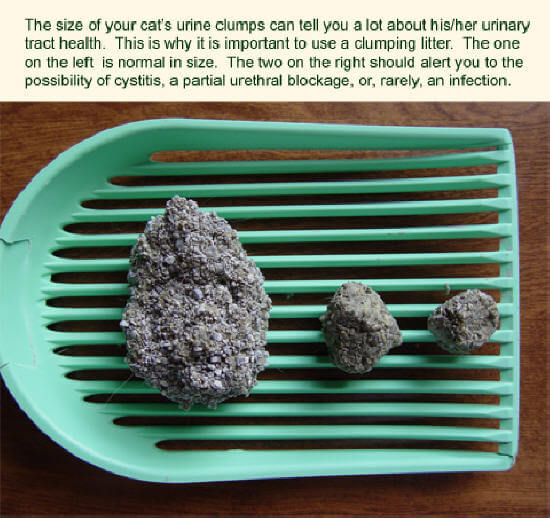
If the cystitis is severe enough, there will be blood in the urine but this blood is not readily apparent once the urine is voided into the litter.
Important: The presence of blood in the urine does *not* necessarily mean that an infection is present.
Cystitis can be a very painful condition! The patient will often start to associate the litter box with his/her pain. This can lead to litter box aversion which causes the patient to urinate elsewhere. In these cases, there may be fewer urine balls in the litter box than usual.
Important: These cats need pain medication such as buprenorphine (Buprenex).
What causes cystitis? I wish that the veterinary community knew the answer to that question in all cases.
What we do know is that cystitis often appears to be linked to stress. The highly concentrated urine that results from being fed a water-depleted (dry food) diet may also be a significant factor in some cats. The concentration of urine is reflected by the urine specific gravity (USG) number found on the urinalysis report. The higher the number, the more concentrated the urine.
(See the Urinalysis/Dietary Issues section below for information and a video regarding how to obtain a urine sample from your cat for a USG measurement.)
We know that bladders are ‘happier’ with more water flowing through them which helps to flush out debris (mucus, cells, crystals) and keep the urine diluted. Dilute urine is thought to be less irritating to the bladder wall. Therefore, we see far more cases of cystitis in dry food-fed cats than in cats eating canned food.
We also know that 99% of cystitis cases in otherwise-healthy patients are *not* due to a bladder infection – contrary to popular belief. The erroneous belief that cystitis is always secondary to an infection leads to the rampant abuse of antibiotics.
It is very troubling to witness the very common practice of ‘shotgun’ treating these patients with antibiotics when most of these cases are sterile (sterile = no infection) cystitis.
It is also very frustrating to see these poor cats leaving the veterinary clinic with no pain medication!
To repeat: We know that stress plays an important role in the cause of cystitis. Can you think of anything more stressful than pain?
See the vicious cycle? Stress can cause cystitis. Cystitis is painful. Pain is very stressful.
Crystals are not thought to be a significant cause of cystitis. This is another very common misconception among both lay people and veterinarians leading to, in many cases, inappropriate usage of acidifying prescription diets which can potentially lead to calcium oxalate stones and exacerbate the bladder inflammation.
That said, dietary management must be considered on a case-by-case basis and one-size-fits-all recommendations with respect to diet composition cannot be given. That said, I will give one ‘one-size-DOES-fit-all’ statement and that is “canned food is always better than dry food due to the appropriate water content in canned foods.”
Bladder stones (aka “uroliths” or “cystoliths”) may or may not contribute to cystitis. However, it is important to examine the urinary tract with radiographs or ultrasound to look for stones. Due to the expense, some people opt to not radiograph or ultrasound the cat on the first visit but, given how common stones are, I would highly recommend checking for stones even on the first visit.
Radiographs and ultrasound each have their pros and cons with respect to imaging the urinary tract and the accuracy/usefulness of each examination method depends on the quality of the equipment and the skill of the operator.
Radiographs – providing there is not a lot of stool in the colon to obscure the view – may reveal a stone in the urethra, whereas U/S will not show this area.
Ultrasound exams have some benefits over radiographs but it is also very highly dependent on operator skill. Ultrasound can pick up stones that may not show up on radiographs.
In some complicated cases, both imaging methods are needed to obtain a diagnosis.

Andrew
Treatments for sterile cystitis include:
- Pain medication;
- increasing water consumption with a canned food diet, etc.;
- decrease the patient’s stress – not always easy since cats can be very ‘silent’ in their stress and we may not always be aware of what is bothering them;
- glucosamine/chondroitin sulfate/hyaluronic acid products such as Cosequin or Trixsyn may help but studies have not supported them as being beneficial. That said, they don’t seem to have any downsides and may be worth a try.
Tricks used to increase water consumption:
- water fountain;
- flavored waters such as tuna water, chicken or beef broth, clam juice, lactose-free cat milk (CatSip), etc. – can be kept in covered (to prolong fresh smell and taste) ice cube trays or frozen in uncovered trays and then transferred to ziplock bags;
- add plain water to canned food – ~1 TBS per meal – or whatever amount your cat likes.
You can make your own tuna water by taking a can of tuna and adding 3 cups of water. Break up the tuna and let it sit for awhile (~15 minutes, give or take) and then pour the tuna water into covered ice cube trays.
3 cups of water fills two 16-cube trays.
After warming the flavored ice cubes to ‘mouse body’ temperature you can:
- add to canned food or
- set out as a separate drink of water.
Subcutaneous fluids may also need to be administered at home by the owner in order to increase urine flow. However, this can be stressful and is usually reserved only for severe cystitis cases involving dry food addicts that are on their way to transitioning to canned food.
To repeat a very important point: Bladder infections are not a common cause of cystitis. Sadly, the rampant abuse of antibiotics when addressing feline urinary tract issues in cats shows that this fact is being ignored. The most important ‘treatments’ are increasing water consumption and lowering stress.
Cats, unlike other species including humans, have a natural defense mechanism in which they produce a more highly concentrated urine. (USG >1.040) Few self-respecting bacteria want to float around in concentrated cat urine.
Before considering the use of antibiotics in cystitis patients, a culture and sensitivity (C & S), in addition to a standard urinalysis, should be run on urine obtained via cystocentesis. This involves a needle going through the abdominal wall, directly into the bladder. This sounds much worse than it really is. The patient does not feel the needle going in but, instead, may simply object to being held on his or her back.
Free-catch urine samples (urine voided onto an exam table or into a litter box) should not be used for a C & S due to the issue of contamination which will often give a false positive result. In other words, bacteria will grow on the culture that may not even be in the patient’s bladder or kidney.
The ‘culture’ part of this test shows if an infection exists or not. The ‘sensitivity’ part of the test is run only if a bacterial colony grows. This half of the test tells us which antibiotic is the best one to choose for the type of bacteria that was grown.
One difficulty that we run into when trying to get a ‘clean’ sample (via cystocentesis) from a cystitis patient is that most of these patients present with an empty bladder. Or, they void all of their urine once the veterinarian starts to palpate (feel) the bladder through the abdominal wall.
To get around this, the patient can be given a dose of pain medication and some subcutaneous fluids and placed in a cage without a litter box for 1-3 hours. This should result in the patient’s bladder filling up enough to obtain a sample for a urinalysis and a C & S.
Please ask your vet to put your cat in a cage in the quietest part of the hospital and put a towel over the cage door to decrease stress.
A note about cost: Many veterinarians do not run a C & S on their cystitis patients because they are worried about running up a client’s bill. However, I cannot stress strongly enough that this is often a pay me now or pay me later issue.
I have seen countless cases where both the veterinarian and the client are ‘chasing their tail’ by pouring needless antibiotics into their sterile cystitis patients. This not only results in added expense and stress for the client, but please also consider the added stress to the patient’s mind and body and the significant potential for promoting bacterial resistance. Most cats are not happy about taking medications and all medications have negative side-effects.
This “tail chasing” often results in far more cost to the client than would have been incurred if a C & S would have been run when the patient first presented with clinical signs.
There is a joke in veterinary medicine that states: “Sterile cystitis patients get better in 1 week with antibiotics and in 7 days without antibiotics.”
The good news is that cystitis often resolves within a few days to a week.
The bad news is that it tends to recur – especially in patients that are fed dry food and/or continue to live in a stressful environment.
See below for further discussion of Urinary Tract Infections.
~~~~~~~~~~~~~~~~~~~~~~~~~~~~~~~~~~~~~~~~~~~~~~~~~~~~~
Urethral Obstruction – Opie’s Story
The urethra is the tube that drains urine from the bladder to the outside. It can be partially or completely blocked with mucus, stones, inflammatory cells, or crystals. This is a life-threatening – and very painful – condition which can result in the bladder rupturing within 24 hours of a complete urethral obstruction – leading to death soon after.
Any cat that is repeatedly entering the litter box but not voiding any urine is in need of IMMEDIATE medical attention! This is one reason why it is so important to use a clumping (scoopable) litter. Clumping litter allows you to see just how much, if any, urine is being voided.
Males are much more prone to blocking than females because the male urethra is much longer and more narrow than a female’s.
The following pictorial shows what Opie had to go through when he blocked. It is highly unlikely that he would have had to suffer like this if he had been fed a proper, species-appropriate diet of water-rich canned food instead of dry food. Opie was found lying in a backyard crying – minutes away from rupturing his bladder due to a urethral obstruction.
A one week stay in the emergency clinic resulted in a $4,000 vet bill. Another $350 bill was incurred 3 weeks later when Opie had to have a stricture broken down in his urethra. Catheterization of the delicate urethra can damage the tissues and result in a stricture which will obstruct urine flow. Repeated catheterizations can set your cat up for serious problems.
Opie’s case is a very good illustration of the fact that proper nutrition (NO dry food) is a ‘pay me now or pay me later’ issue.
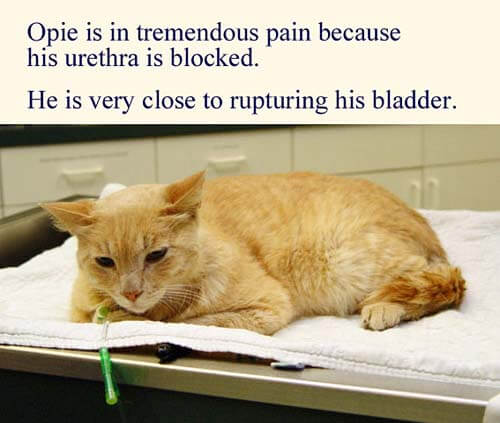
Opie was sedated and a catheter was passed up his urethra in order to break up the obstruction before his bladder ruptured. His bladder was then flushed to try to remove any debris that could cause him to block again.
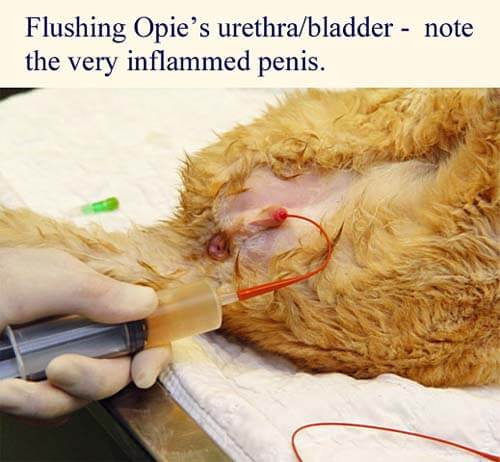
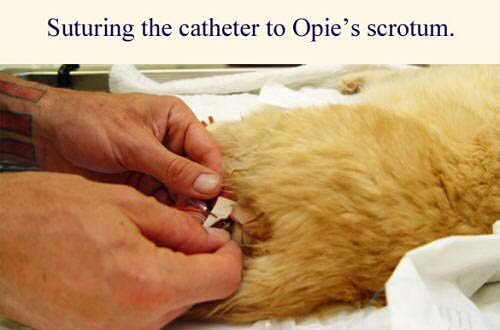
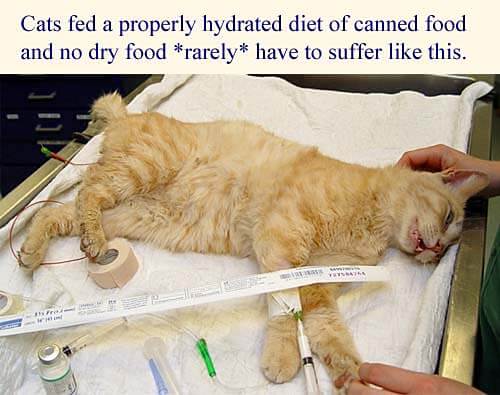


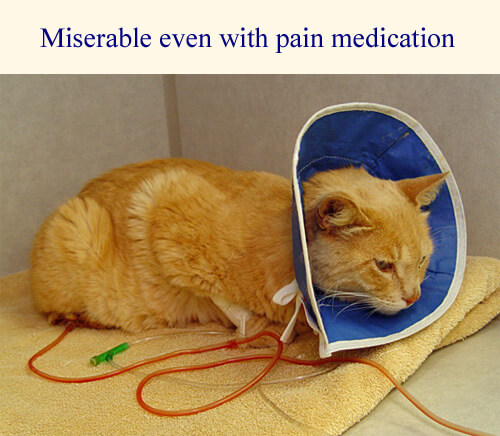
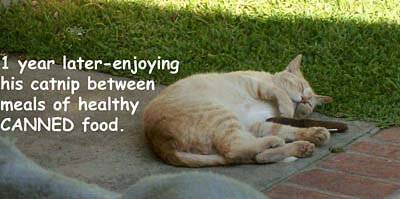
Is it possible for a cat to block when on a 100% canned food diet? Yes, it is possible, but it is highly unlikely. When water is flowing through the bladder, crystals, mucus, and cellular debris will be much less apt to build up and cause an obstruction.
Also, when water is flowing through the bladder, the urine is more dilute which is thought to be less irritating to the bladder wall in some cats. Less irritation means less inflammatory cells and mucus to block the urethra.
Think of canned food as rinsing out your cat’s bladder many times each day.
A procedure called a perineal urethrostomy (PU) is often performed on blocked cats with the hope of preventing future obstructions.
A PU removes the penis and part of the urethra and leaves the patient very prone to urinary tract infections for the rest of his life. Also, the surgery site can stricture at a later time.
I strongly believe that this procedure is performed far too early in many cases before a properly hydrated diet is tried. Please give this procedure a lot of thought before consenting to it.
In December 2012 I consulted with 6 owners of blocked cats over a 10-day period of time. (Yes, this cause of suffering is that common…) Unfortunately, one was unable to get to a veterinarian in time and his bladder ruptured resulting in a very slow and painful death.
The other 5 cases were being threatened with penis amputation (PU surgery) by the primary care veterinarian. I am happy to report that, one year later, all cats are doing well – with their penis intact. They are, of course, eating only a water-rich, low mineral, diet and no dry food.
~~~~~~~~~~~~~~~~~~~~~~~~~~~~~~~~~~~~~~~~~~~~~~~~~~~~~~
Urinary Tract Infection
Urinary tract infections can occur anywhere along the tract from the kidneys to the urethra. Most infections gain access to the bladder when bacteria travel up the urethra from the outside world. From the bladder, the infection can ascend to the kidneys.
Please note that when the abbreviation “UTI” is used, the ‘I’ must be defined. Does “I” mean infection? Or does it mean inflammation?
It is very important to understand the difference if we are to stop overusing antibiotics and start using more pain medications when cats exhibit signs of urinary tract problems.
Studies have shown that otherwise healthy cats (no kidney disease, diabetes, or hyperthyroidism) – that are showing signs of urinary tract discomfort – have only a ~1-2% chance of having a UT infection yet antibiotics are prescribed very frequently for these patients. The veterinary (as well as human) medical community needs to address this very serious problem involving the overuse/abuse of antibiotics.
Roughly 99% of these otherwise healthy cats have sterile (no infection) cystitis. This is because the feline is very good at saving water to stay hydrated which results in a very concentrated urine. (Urine Specific Gravity [USG] >1.040) Concentrated urine is a very hostile environment that does not readily support bacterial growth. Therefore……
Urinary tract infections are rare in cats without a concurrent disease such as kidney insufficiency, diabetes, or hyperthyroidism.
What about the other population of cats with diseases such as kidney insufficiency, diabetes, or hyperthyroidism? Cats with chronic kidney disease (CKD) and hyperthyroidism often produce a more dilute urine (USG <1.030) which is a friendlier environment for bacteria. Unregulated diabetic cats often have glucose (sugar) in their urine which makes a nice culture medium for bacteria.
However, even cats with CKD, hyperthyroidism, or diabetes that are showing signs of lower urinary tract disease have a less than 30% chance of having a urinary tract infection. (Several studies have been done in this area and the results have varied but all have shown less than 30%.) This fact illustrates why it is very important to run a culture and sensitivity.
Urine Culture and Sensitivity (C & S)
As described above in the Cystitis section, this is a two-part test that is used to check to see if an infection is present (culture) and what antibiotic(s) would be the most appropriate to use for the strain(s) of bacteria present (sensitivity).
Please note that I emphasized “if” in the previous sentence. It is very important to confirm that an infection actually exists rather than to subject your cat to the administration of an unnecessary, and potentially dangerous, antibiotic without proof that it is needed and is the correct one.
Culture results are reported over a period of 3 days – at a minimum. The typical sterile cystitis report will read:
24 hours – no growth
48 hours – no growth
72 hours – no growth
If there is an infection present, the report will read something like “moderate growth of e.coli – sensitivity pending.” This means that the next report will give your veterinarian important information necessary to pick the best antibiotic for your cat’s infection.
Cultures can be classified in 3 ways:
1) diagnostic – the initial culture before starting antibiotics to confirm that an infection is present and to identify the bacteria, assess the number of bacterial colonies to quantify the level of infection (cfu – colony forming units per milliliter of urine), and to determine the organisms’ susceptibility to various antibiotics
2) therapeutic – performed 3-5 days after starting antibiotics (after a positive diagnostic culture) to assess antibiotic efficacy or it is sometimes performed 3-5 days before cessation of antibiotic administration
3) surveillance – performed 7-14 days after the last antibiotic dose to check for relapse or re-infection
Relapses are defined as recurrences caused by the same species and strain of microorganism that were found in the diagnostic culture within several weeks of stopping antibiotic therapy.
Re-infections are defined as recurrent UT infections caused by a different organism. The only way you can differentiate relapses from re-infections is to compare the results of the initial culture obtained prior to antibiotic usage to those of cultures obtained during and/or after discontinuation of the antibiotic.
Relapses represent a possible antibiotic treatment failure that may have resulted from improper antibiotic choice, dose and duration of therapy, lack of owner or patient compliance, failure of the patient to absorb an orally administered drug, deep-seated infections, failure to identify predisposing factors, or acquired drug resistance.
Re-infections, on the other hand, usually represents failure to recognize and eliminate predisposing factors associated with continuing dysfunction of host defenses, or UT infections caused by procedures such as catheterization or perineal urethrostomy (PU) surgery. Frequent re-infection is an absolute indication to evaluate the patient for anatomic, metabolic, and immunologic disorders that may compromise normal host defenses.
It is important to understand that when a cat has had his penis amputated (PU surgery) a vital barrier to infection has been removed.
For a patient’s first time infection, therapeutic and surveillance cultures are not usually performed due to cost and added stress for the patient. However, they should be considered in all recurrent UT infection cases, otherwise the veterinarian and owner may find themselves running in circles.
To repeat an important point: Cats with a urine specific gravity above ~1.040 have a very low chance (~1-2%) of having a urinary tract infection.
Cats with a USG below ~1.030 have a higher chance of having an infection.
If a patient presents with lower urinary tract signs, and has a low urine specific gravity or is a diabetic cat that is spilling sugar in his urine, and if an in-house analysis of the urine indicates that an infection may be present, the patient may be started on a broad spectrum antibiotic pending the C & S result.
If the culture turns up negative, the antibiotic can be discontinued. Or if the culture comes up positive but shows that the bacteria are resistant to the antibiotic that has been chosen, the correct antibiotic can be started.
At least in these cases, the needless – or wrong – antibiotic will have been given for only 3 days instead of for a much longer period of time.
An important note regarding the long-acting antibiotic called Convenia:
Because this drug stays in the body for a very long time (up to ~60 days) it is one of the newest antibiotics to be terribly overused/abused. Veterinarians and lay people are seeing it as a quick and easy fix to their problems because they don’t have to give it once or twice daily like with other antibiotics. It is typically given by injection. If a second one is administered, it is given again in 2 weeks. However, keep in mind that if an adverse reaction occurs, you cannot retrieve the drug from the body.
Convenia can cause severe anemia, as well as other serious health problems. (Please see the Convenia – Worth the Risk? webpage on this site.) There is a report on VIN (Veterinary Information Network) from a general practitioner who dealt with two cats that died within 10 days of receiving Convenia. They were otherwise healthy cats and had normal red blood cell counts prior to receiving Convenia. There is no absolute proof that Convenia caused their deaths but there is an extremely high index of suspicion that this drug was the culprit since this class of drugs is known to cause anemia.
I also dealt with case of severe anemia post-Convenia in an otherwise healthy cat. The emergency clinic was able to save the patient’s life after a 1 week stay in the hospital. The bill was over $6,000.
Please do not allow this drug to be given if the cat is able to be medicated with a safer antibiotic.
Baytril is another antibiotic that is frequently overused. This drug can cause blindness (very rarely) so I do not take its use lightly.
Clavamox is the most common broad-spectrum antibiotic that is administered to cats. It causes vomiting and/or diarrhea in some cats but it is one of the safer choices of antibiotics. It comes in pill or liquid form. I greatly prefer the pills because they are very palatable and can be crushed and added to canned food, or administered in a small piece of a Pill Pocket.
Never use a whole Pill Pocket since they are too large making it far more likely that the cat will bite down on the pill versus swallowing it whole. I do not like ‘pilling’ cats so if your cat will not eat crushed clavamox tablets in tasty canned food or baby food or in a Pill Pocket, then use the liquid formulation. (See the Pilling Cats webpage on this site.
~~~~~~~~~~~~~~~~~~~~~~~~~~~~~~~~~~~~~~~~~~~~~~~~~~~~~~~~~~~~
Urinalysis/Dietary Issues
Laboratory analysis of urine (UA) can be done on samples obtained in various ways but you need to be aware that some tests are not accurate on free-catch samples that you have obtained at home.
Due to the delay in testing of the sample (by more than 30 minutes once the urine has been voided), temperature changes, and the lack of sterility of a free-catch sample, interpretation of a urine sample obtained at home can be very misleading.
One example of a test that is accurate is the urine specific gravity. This is also one of the most important numbers on the UA. I routinely (3-4x/year) check my cats’ USG from free-catch samples obtained by slipping a flat (versus a deep/narrow) tablespoon under them when they are urinating.
A low USG can be an early indication of kidney insufficiency so I like to monitor any cat over 10 years of age several times each year.
Watch this video for information regarding obtaining free-catch urine samples:
When assessing a patient’s urine concentrating status, it is always much better to take multiple readings so that you can see an average over time – versus relying on just one reading, at one static point in time, from a UA report. Therefore, some people buy their own refractometer in order to check their cat’s USG at home. If you do purchase one, make sure that it is labeled for use with urine. The RHC-200 ATC (automatic temperature compensation) linked here has been sold on eBay for as little as $50.
The RHCN-200 ATC is billed as a “Heavy Duty Version of the RHC-200 ATC and features an easy-to-calibrate knob” versus the need to use a small screwdriver (easily lost or misplaced) for the RHC-200 ATC model. Either one will be fine because you don’t have to calibrate the unit very often. In fact, my 36 year old one has only been calibrated a few times in its life but I would suggest that you calibrate yours ~once or twice a year with distilled water which will have a specific gravity of 1.000. Calibration is very easy. Just apply a couple of drops of distilled water onto the refractometer window then adjust the refractor line to 1.000 with the screwdriver or the knob.
A urine culture and sensitivity is not accurate from a free-catch sample due to contamination issues. However, on rare occasions we may run a C & S from a midstream sample that is caught in a sterile container but interpretation must take into consideration the collection method. If the C & S comes back negative on a free-catch sample, this result is helpful but if it comes back positive, you cannot be sure if the bacteria are from the bladder/kidney or from the very end of the urinary tract or the patient’s hair that surrounds the vulva or penis.
A check for crystals is also not accurate because crystals can form once outside of the bladder in as quickly as 20 – 30 minutes. This problem of a ‘false positive’ can be an issue with urine obtained from a free-catch sample at home, as well as one obtained via cystocentesis that is sent to an outside lab due to the same time delay. If your vet wants to accurately assess for crystals, the urine must be looked at ‘in-house’ within 20 – 30 minutes of cystocentesis or the urine being voided.
pH also may not be accurate in urine samples obtained at home.
A cystocentesis is the best method to obtain urine which will yield the most accurate results.

A few definitions, along with comments:
pH:
pH refers to the acidity or alkalinity of, in this case, urine. pH is often mentioned when discussing diet and crystals but is focused on far too heavily.
While keeping in mind that cats are obligate carnivores (see Feeding Your Cat: Know the Basics of Feline Nutrition), it is important to understand that a meat-based (carnivorous) diet naturally leads to an mildly acidic urine.
Grains, on the other hand, promote a more alkaline urine due to their carbohydrate level as shown by this study.
Due to humans’ focus on profit margin, diets higher in grains (higher in carbohydrates than a cat’s natural diet) have flooded the market – along with pet food manufacturers’ unscrupulous advertising onslaught designed to persuade the feline caregiver to think that feeding a water-depleted, grain-laden dry food diet constitutes optimal nutrition.
Keep in mind: Meat is expensive. Grains are cheap.
Meat (animal-based protein) promotes a mildly acidic urine which is normal for the cat.
Grains (plant-based protein and high carbohydrate content) promote an alkaline urine.
As mentioned below in the Crystal section, struvite crystals are more apt to form in an alkaline urine and calcium oxalate crystals are more apt to form in an acidic urine. Many ‘urinary tract’ diets – including some of the prescription diets – overly acidify the diet past what would be normal for a cat eating a species-appropriate diet. These diets can dissolve struvite stones but will lead to other problems, such as calcium oxalate stones, if they are fed past the therapeutic time frame.
Please understand that we would rarely have to address pH or crystals if cats were fed a water-rich diet. However, due to the fact that humans insist on feeding cats species-inappropriate, water-depleted diets in the dry form because they are cheaper and more convenient to deal with and because many cats are addicted to them, members of this species continue to suffer with urinary tract issues.
For many years, struvite (magnesium, ammonium, and phosphorus) was the predominant mineral mixture found in cat urine due to the species-inappropriate level of grains in cat food. Knowing this, humans stepped in and started acidifying commercial cat food with things like dl methionine – instead of cutting into profit margin by removing the grains and going back to meat.
The so-called ‘urinary tract formulas’ were born.
Unfortunately, in trying to ‘fix’ a cat’s unnatural alkaline urinary pH – caused by human greed in the first place – pet food manufacturers created even more problems by adding urinary acidifiers in the form of dl methionine, etc., which led to the formation of calcium oxalate (CaO) crystals/stones in many cats. Suddenly, there were far more patients suffering with CaO crystals/stones than there were patients with struvite crystals/stones.
One of the most serious problems with this fact is that CaO stones can only be removed with surgery. There is no way to dissolve them with dietary manipulation. Struvite stones, on the other hand, are more amenable to dissolution with dietary manipulation.
Most stones found in the kidney are CaO and since we cannot dissolve them with dietary manipulation and since surgery to remove kidney stones (versus bladder stones) is not a safe option, it is easy to see how damaging the effects of feeding an acidifying diet can be if used for long periods of time.
Other systemic problems, including kidney damage and low potassium, can be seen in conjunction with the feeding of these acidifying diets, as well.
It is also important to note that diet is not the only factor involved in determining urine pH. The timing of the cat’s meals is also a factor. ‘Post-prandial alkaline tide’ refers to the fact that urine pH will become more alkaline after eating a large meal. Therefore, it is suggest that cats eat multiple small meals throughout the day to help keep the pH in a normal range. Small cats in the wild eat 8-10 small meals per day.
pH can also be affected by certain medications, vomiting, chronic kidney disease, urinary tract infection, diet, stress, and as already discussed, the timing of the last meal.
If humans would just go back to feeding cats a species-appropriate diet – i.e. – one that has a water content that mimics a cat’s normal prey and one that is based on meat, not gains – instead of trying to artificially manipulate a species-inappropriate diet of grains by adding acidifiers, the vast majority of urinary tract problems would be solved.
- Crystals are most commonly either calcium oxalate (CaO) or struvite (a mixture of magnesium, ammonium, phosphate).
- Calcium oxalate crystals are more apt to be formed in an acidic environment.
- Struvite crystals are more readily formed in an alkaline environment.
- A small amount of crystals is not an abnormal finding in cat urine and the cat should not be automatically put on a prescription diet such as Hill’s Prescription c/d, etc.
- Crystals are often erroneously diagnosed because they can form once the urine has been removed from the bladder. Therefore, when urine is sent off to an outside laboratory, or a sample is brought from home, a report of “crystals” is somewhat meaningless since you have no idea if they were actually present within the patient. This misdiagnosis – and overemphasis of the significance of urinary crystals if they are present in the bladder – leads to the client becoming alarmed and the patient needlessly being put on a low quality – and potentially dangerous – diet such as one of the prescription ‘urinary tract’ diets.
Think of crystals in cat urine like leaves on your driveway. Both are normal findings. However, if you never hose (or sweep….during a water shortage :>)) down your driveway, the leaves will build up and then you won’t be able to get your car out of the garage.
If crystals are allowed to build up, the urethra can become blocked leading to a life-threatening situation. A blocked cat can end up with a ruptured bladder – resulting in death – within 12 -24 hours of complete obstruction.
If there is not enough water flowing through the bladder on a regular basis the following will happen with respect to crystals:
- The urine specific gravity goes up meaning that the urine becomes more concentrated. When this happens, the crystals are more apt to become ‘super-saturated’ in the urine and form stones.
- Mechanical removal is compromised. When there is ample water flowing through the bladder the cat will urinate more frequently – voiding up to double the amount of urine per day. This frequent urination of a higher volume of urine helps to remove the crystals instead of letting them build up to block the urethra.
- If there are large numbers of crystals and the cat also has cystitis (inflammation of the bladder leading to mucus production and cellular debris), the crystals can combine with the mucus and inflammatory cells and make a ‘plug’ that can block the urethra.
Keep in mind that it is very important to have enough large litter boxes with CLEAN clumping (scoopable) litter in accessible places so that your cat is very willing to use them frequently and not ‘hold his urine.’
More frequent voiding of urine will lower the chances of stones being formed and will make the bladder wall less likely to become inflamed.
Litter boxes should always be scooped at least twice daily.
Urine Specific Gravity (USG):
As noted previously on this webpage, USG is a measurement of the concentration of the urine. It is one of the most important values on the UA report.
USGs should be measured on more than one occasion to check for consistency. A dilute USG would be around 1.015 (stated “ten fifteen”) or 1.020 (“ten twenty”) and a concentrated urine would be more in the >1.040 range. A USG between these ranges should be monitored to see if it continues to go lower or starts to rise.
The USG of dry food-fed cats is higher (the urine is more concentrated) than it is for canned food-fed cats.

Robbie
Prescription Diets
Please review what I wrote about diet issues at the top of this page in the grey box and also keep in mind what was discussed above regarding the fact that urine crystals are often erroneously diagnosed and the fact that they are NOT necessarily an abnormal finding that needs to be ‘treated’ with a prescription diet.
If you need help beyond the scope of this webpage I am available for phone consultations but please note that many people write to me asking questions that are already addressed on this webpage.
That said, there is a lot of content here and it can be quite confusing. Therefore, if you want to address it verbally in more detail and also as it pertains to your own cat, you can contact me for a consultation appointment.
~~~~~~~~~~~~~~~~~~~~~~~~~~~~~~~~~~~~~~~~~~~~~~~~~~~~~~
I do not use use ‘prescription’ diets except in rare cases as noted below. They are expensive and contain low quality, species-inappropriate ingredients, and are not necessary in most cases of feline urinary tract disease.
I only consider the temporary use of Hill’s canned s/d if I know that the patient has urinary tract stones (“uroliths”), or a large amount of crystals – with a high index of suspicion for them being struvite versus calcium oxalate (CaO).
I tend to reach for canned s/d more readily in a male cat than a female. This is because males are much more prone to a urethral obstruction than females due to their long, narrow urethra.
In these cases, I will consider the use of canned s/d (the most acidifying diet on the market) for a short period of time until the patient shows radiographic or ultrasound evidence of stone dissolution/crystal clearance. This can take as little time as a few days but may take 1-2 months for large stones.
If the stones are not showing any signs of dissolution once the patient has been on the acidifying diet for 2 – 3 weeks, there is a very good chance that the stones are CaO and keeping them on this diet is only going to make matters worse. This is why it is so important to monitor the patient with radiographs or ultrasound and urinalyses and to not just leave them on s/d.
Remember, CaO will not dissolve with diet manipulation and Hill’s s/d will actually promote the formation of CaO – creating a dangerous situation. Surgery is the only way to remove CaO stones and if they form in the kidney (more common than the easier-to-access bladder), they cannot be removed without significant risk to the patient.
‘Sludge’ (cellular debris, mucus, proteinacious material, etc.), can be addressed with simply a water-rich diet (canned or homemade diet with added water) to flush it out but it is possible to have small stones hiding in this mixture that could be missed on radiographs or ultrasound and which could result in urethral blockage.
If your cat has a large amount of sludge in his bladder that you are now addressing with diet (s/d or simply canned/homemade food with added water), be sure to watch him carefully for any signs of a urethral blockage. I would not want to leave a cat like this unattended for more than ~12 hours in case he blocked.
Also note that meat-based diets promote an acidic urine (but not overly acidic like Hill’s s/d) and that carbohydrate-based diets promote an alkaline urine. Keep in mind that carbohydrates have no logical place in the feline diet.
Other prescription diets such as Hill’s c/d, Royal Canin SO, and Purina UR are diets that do not aggressively acidify the urine like Hill’s s/d does.
Therefore, c/d, SO, and UR can be fed for life but I would not recommend it due to their cost and unhealthy ingredients and species-inappropriate composition.
Hill’s s/d, on the other hand, is NOT safe for long-term feeding and should only be used temporarily.
When urinary tract prescription diets were first formulated, they mainly focused on urinary pH manipulation and magnesium restriction. In recent years, some of the manufacturers such as Purina and Royal Canin have added salt to their diets to encourage higher water consumption in order to dilute the minerals (crystals). There is controversy surrounding this practice.
Prescription urinary tract diets come in dry and canned forms but after reading this webpage, hopefully the reader will understand just how illogical it is to add salt to a dry food diet to get the cat to drink more water when the cat should be eating a water-rich diet of canned food in the first place.
For dry food addicts, please see Tips for Transitioning Dry Food Addicts to Canned Food.
As stated in the first section of this webpage, manipulating the pH of urine is not the most important factor in preventing feline urinary tract diseases yet it is so heavily focused on.
I am finding it increasingly frustrating to watch the veterinary community continue to be fixated on the pH of cat urine and the presence of urinary crystals instead of focusing on the much more important issue of dietary water content.
Veterinarians are exhibiting a serious lack critical thought when prescribing a water-depleted diet to any cat but especially one with urinary tract issues, including kidney disease which is very common in cats.
Instead of reflexively reaching for the prescription diets when patients present with urinary tract issues, I would like to see the emphasis switch to getting the patient off of all dry food and onto a meat-based canned food with added water.
This diet will help maintain a species-appropriate urine pH and will keep the bladder flushed out.
When I say it is illogical to feed “any” cat a diet of dry food, think about practicing preventative nutrition. Do you really want to wait until your cat develops urinary tract problems before you implement the feeding of a water-rich diet to a species with a naturally low thirst drive?
Think about closing the barn door before the horse is running down the roadway.
May 2025
December 2016
Lisa A. Pierson, DVM